Every molded plastic part, whether it’s a bottle, enclosure, pipe, panel, tank, or precision gear, starts with a critical decision: Which molding process fits this part best?
That choice dictates tooling cost, cycle time, surface quality, tolerances, and even whether the part can be manufactured consistently at all.
The challenge is that each molding process comes with specific strengths, limitations, material rules, and geometry constraints. Some excel at high-precision components, others at hollow shapes, continuous profiles, large low-pressure forms, or thin-walled packaging.
Pick the right one and production runs smoothly; pick the wrong one and you’re fighting defects and cost overruns from day one.
This guide breaks down each major plastic molding process in a way that’s concise but technically accurate how it works, the equipment involved, compatible materials, and what it’s best suited for.
It closes with a practical selection framework to help you align part requirements with the most efficient manufacturing method.
In simple terms, plastic molding is the process of shaping molten or softened polymer using a mold, die, or form. How that shaping occurs varies by process, and that’s what we clarify here.
Key Takeaways
Each molding process serves a different purpose: injection molding for precision, blow molding for hollow parts, extrusion for continuous profiles, compression for thermosets, rotational molding for large hollow forms, and thermoforming for thin-walled shells.
Equipment and materials vary by process, from high-tonnage injection presses and multi-cavity molds to extruders, rotomolding ovens, and thermoforming stations, each supporting specific polymer families.
Tooling cost and production volume drive process selection: injection molding suits high-volume runs, while rotational, compression, and thermoforming work well for lower-volume or large-format parts.
Part geometry and tolerances are the biggest constraints: sharp features, fine textures, uniform wall thickness, and precision fits strongly influence which molding method is viable.
A structured decision framework helps you choose the right process, ensuring manufacturability, cost control, reliable cycle times, and consistent part quality.
The Main Types of Plastic Molding Processes
Different molding processes exist because no single method can efficiently produce every type of plastic part. Each process has its own rules for geometry, economics, tolerances, and material behavior.
This section breaks down the major molding technologies so you can quickly see how each one works, the equipment involved, the materials it supports, and where it fits best.
Injection Molding
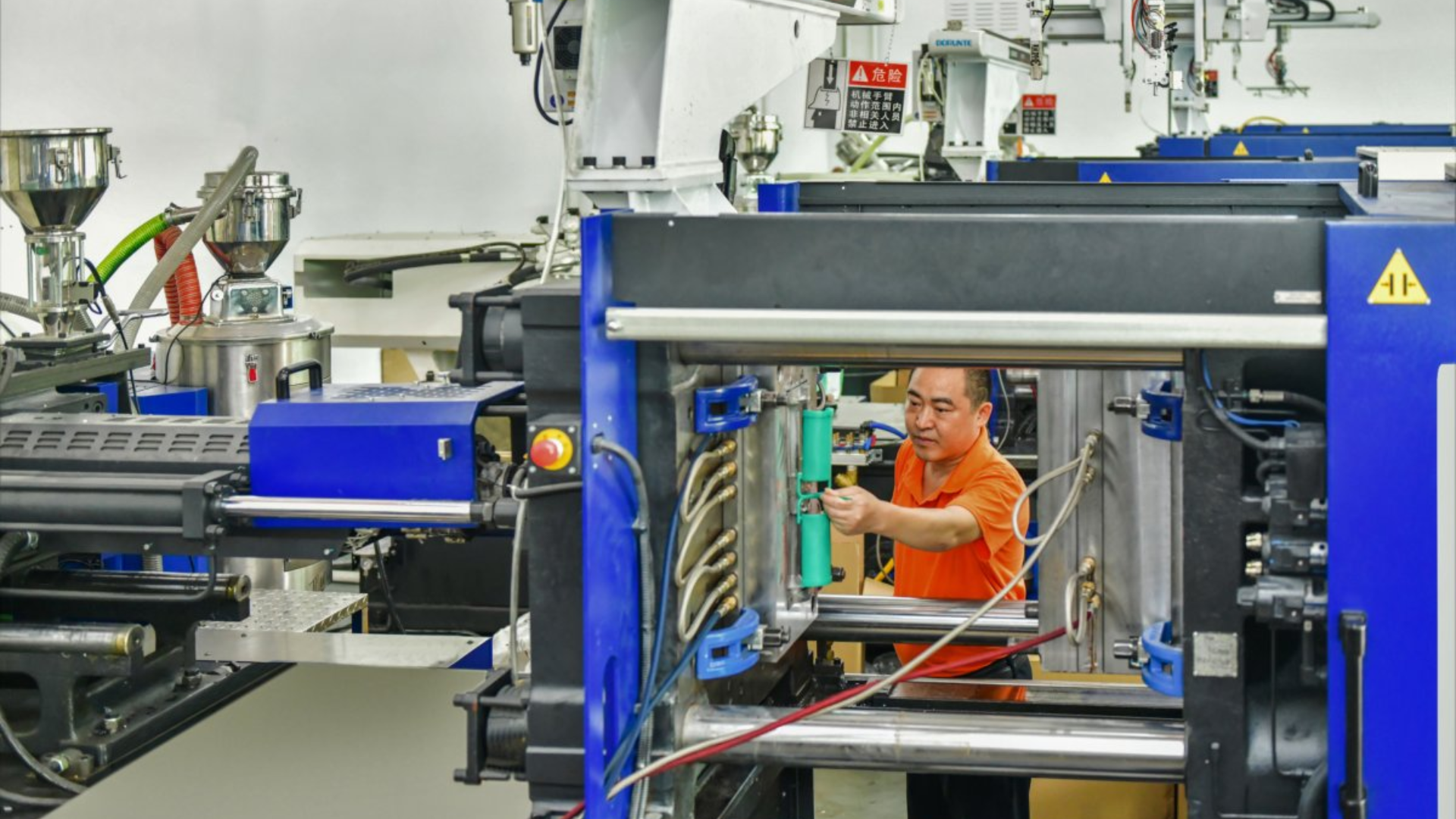
How It Works: Plastic pellets enter the heated barrel, where the screw performs three critical functions simultaneously: melting, metering, and pressurizing the material. Once the metering phase is complete, the screw moves forward as a plunger, injecting the molten polymer into a tightly closed mold at controlled velocity and pressure.
After the cavity fills, the machine holds pressure to compensate for shrinkage, then cools the part until it becomes dimensionally stable. When the mold opens, ejector pins push the part out, and the cycle repeats, often in under 10 seconds for high-speed packaging.
This closed-loop sequence enables precise control of flow front behavior, gate freeze, packing density, and dimensional repeatability.
Equipment
Injection unit (screw + barrel)
Clamp unit (tonnage matched to projected area)
Tooling: single/multi-cavity, hot runner or cold runner
Optional: valve gates, in-mold sensors
Materials: PP, ABS, PS, HDPE, Nylon (PA), PC, POM, TPU, blends (PC/ABS)
Applications: Connectors, housings, gears, medical components, consumer products, automotive clips.
Best For: Tight tolerances, complex geometry, high-volume production, consistent surface finish.
Watch-Outs / Limitations: High tooling cost, strict DFM rules, sensitive to gate design, cooling layout, and material moisture content.
Blow Molding
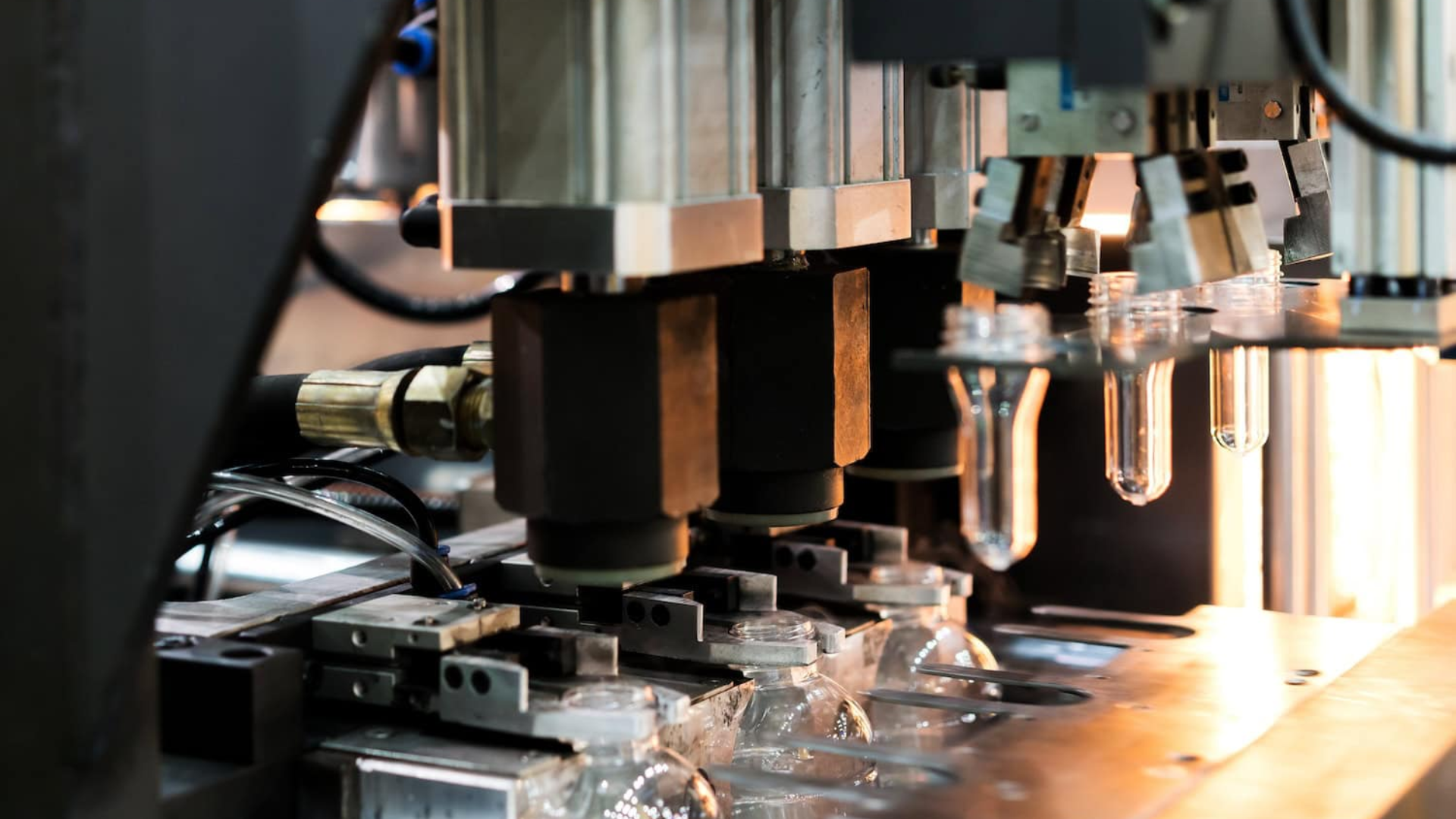
How It Works: The process begins by forming a parison (extrusion blow) or a preform (injection blow/stretch blow). While the material is still hot and pliable, it is enclosed inside a mold cavity. Pressurized air is then introduced, inflating the material outward until it contacts the mold walls.
In extrusion blow, the parison is pinched at the bottom, inflated, cooled, and trimmed.
In injection blow, the preform made with injection molding accuracy ensures perfect neck geometry.
In stretch blow, the preform is mechanically stretched before inflation, aligning polymer chains for improved clarity and strength (PET bottles).
Wall thickness ultimately depends on parison control, stretching ratio, and material flow during inflation.
Variants
Extrusion Blow Molding (EBM): continuous parison
Injection Blow Molding (IBM): injection-molded preforms for precision necks
Stretch Blow Molding (ISBM): biaxially stretched for PET bottle clarity & strength
Equipment: Extruder or injection unit + blow station, parison die or preform mold, trimming/deflashing systems.
Materials: HDPE, LDPE, PP, PET, PVC (limited), PC (specialized). PVC is usable but requires careful thermal control to prevent HCl release and mold corrosion.
Applications: Bottles, drums, tanks, automotive ducts, detergent containers.
Best For: Lightweight hollow parts, thin but functional walls, uniform distribution in bottles.
Watch-Outs / Limitations: Parison sag, wall-thickness variation, flash generation (in extrusion blow), limited feature complexity.
Extrusion Molding
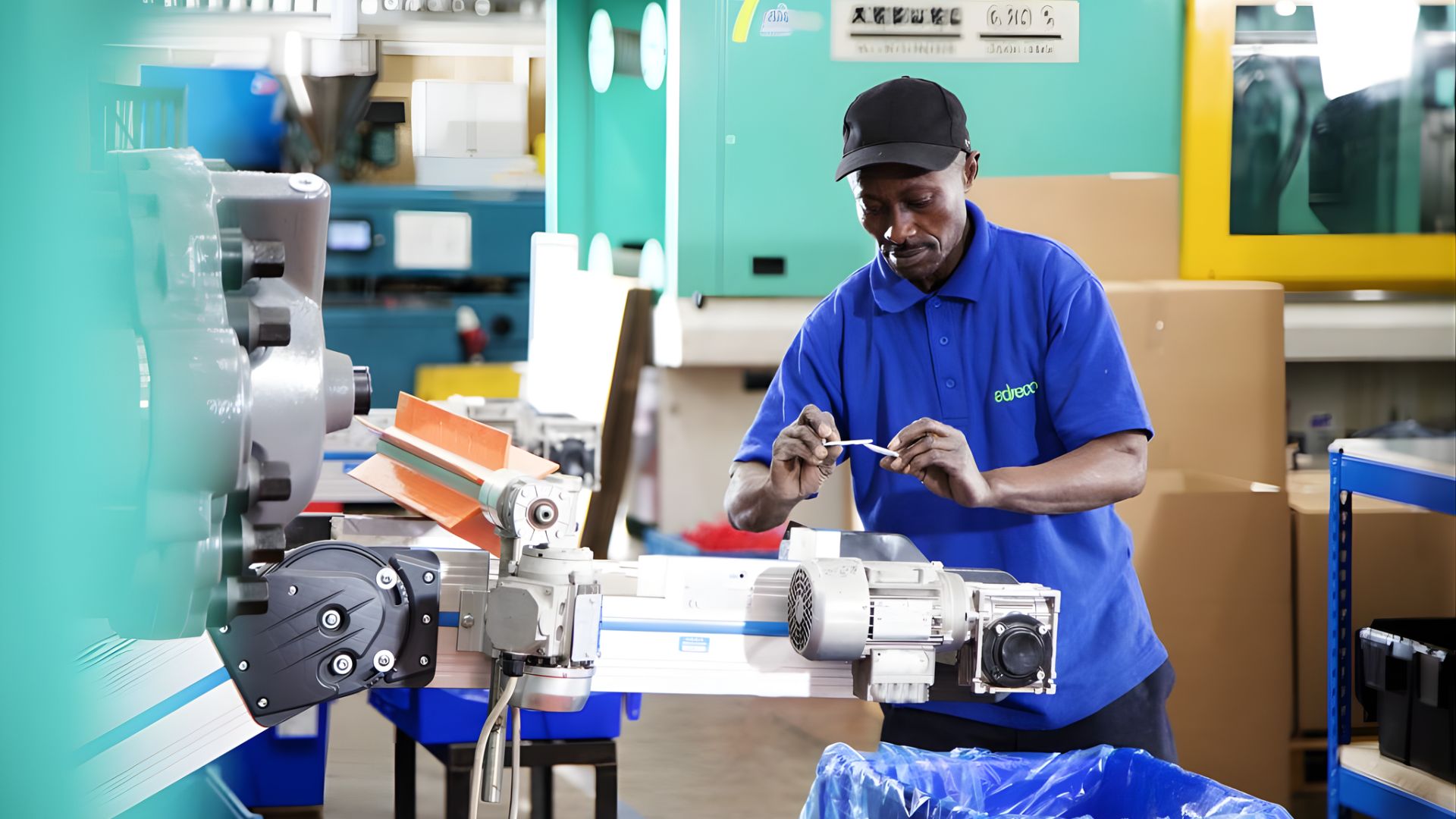
How It Works: Material enters a rotating screw, where it is conveyed, melted, mixed, and pressurized. Unlike injection molding, the melt never pauses; it flows continuously. The molten polymer is pushed through a die whose opening defines the cross-section of the final product.
Once it exits the die, the hot profile or sheet passes through a cooling system:
water bath (for pipes/tubes)
calibration table (for window profiles)
chill rolls (for sheet/film)
A puller or winding system maintains constant tension so the product cools without warping. The process is highly dependent on stable melt temperature, die design, cooling rate, and haul-off speed.
Equipment
Single-screw or twin-screw extruder
Profile/sheet/film die
Cooling tank or chill rolls
Puller/haul-off
Cutters, winders, or saws
Materials: PE, PP, PVC, PETG, EVA, TPEs, and some engineering thermoplastics.
Applications: Pipes, tubes, window profiles, seals, wire coatings, sheets, multilayer films.
Best For: Long, continuous products with uniform cross-sections; high material throughput.
Watch-Outs / Limitations: Die swell, sensitivity to screw design, cooling uniformity, and thickness variation in films.
Compression Molding
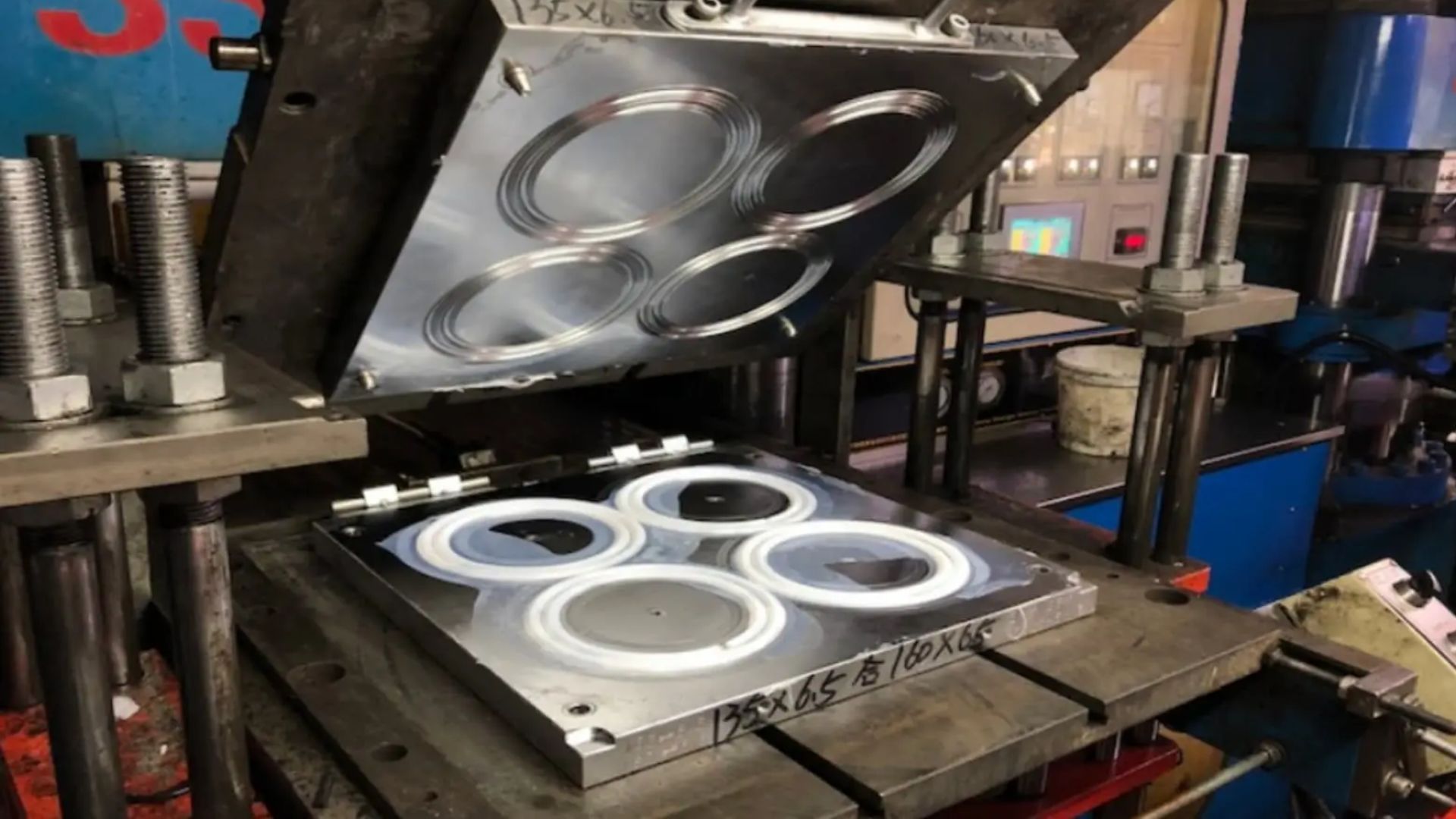
How It Works: A measured charge of material, either a pre-weighed “slug,” a sheet (SMC), or a bulk compound (BMC), is placed into the lower cavity of a heated mold. As the press closes, the material begins to flow and fill the cavity before undergoing a chemical cure.
Unlike injection molding, there is no shear-driven melting; the material softens from heat and is shaped under steady pressure. During the cure stage, crosslinking reactions occur (for thermosets), locking the part into its final shape.
The process produces extremely strong, consistent parts because the material undergoes minimal flow-induced stress.
Equipment: Hydraulic or mechanical presses, matched-metal molds, heated platens.
Materials: SMC, BMC, phenolics, rubber compounds, and some reinforced thermoplastics.
Applications: Automotive structural panels, electrical housings, appliance components, high-strength parts.
Best For: Thick walls, high-strength composites, low–medium volume runs, parts needing high heat resistance.
Watch-Outs / Limitations: Longer cycles due to curing, heavier tools, limited detail vs injection molding.
Rotational Molding
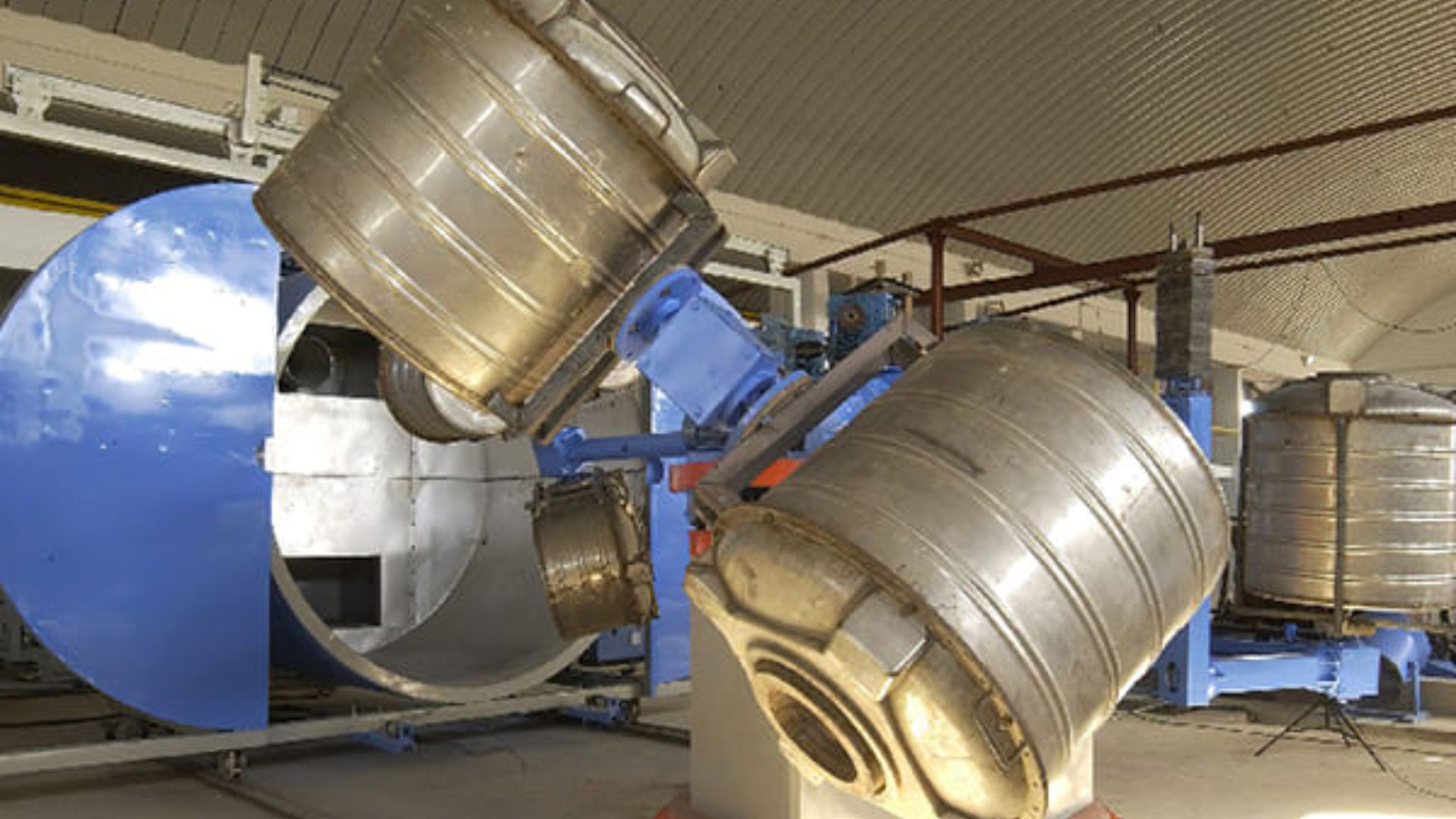
How It Works: The mold is charged with PE powder, sealed, and placed into an oven. As the mold rotates around two perpendicular axes, the powder gradually melts and spreads to coat every interior surface.
There is no internal pressure; coverage depends purely on heat and rotation.
Once the resin fully melts, the mold moves into a cooling zone while rotation continues to maintain uniform wall thickness. When cooled, the part shrinks slightly and releases from the mold walls.
Rotomolding is ideal for large shapes because the polymer forms a single, seamless structure, reducing stress and eliminating weld lines.
Equipment: Rotomolding machine, oven, cooling chamber, aluminum or steel molds.
Materials: LLDPE (primary), XLPE, some nylons (less common)
Applications: Tanks, bins, kayaks, playground structures, large industrial containers.
Best For: Very large hollow shapes, stress-free walls, low tooling cost, flexible volumes.
Watch-Outs / Limitations: Long cycle times, lower precision than injection or blow molding, limited material diversity, and surface finish constraints.
Thermoforming & Vacuum Forming
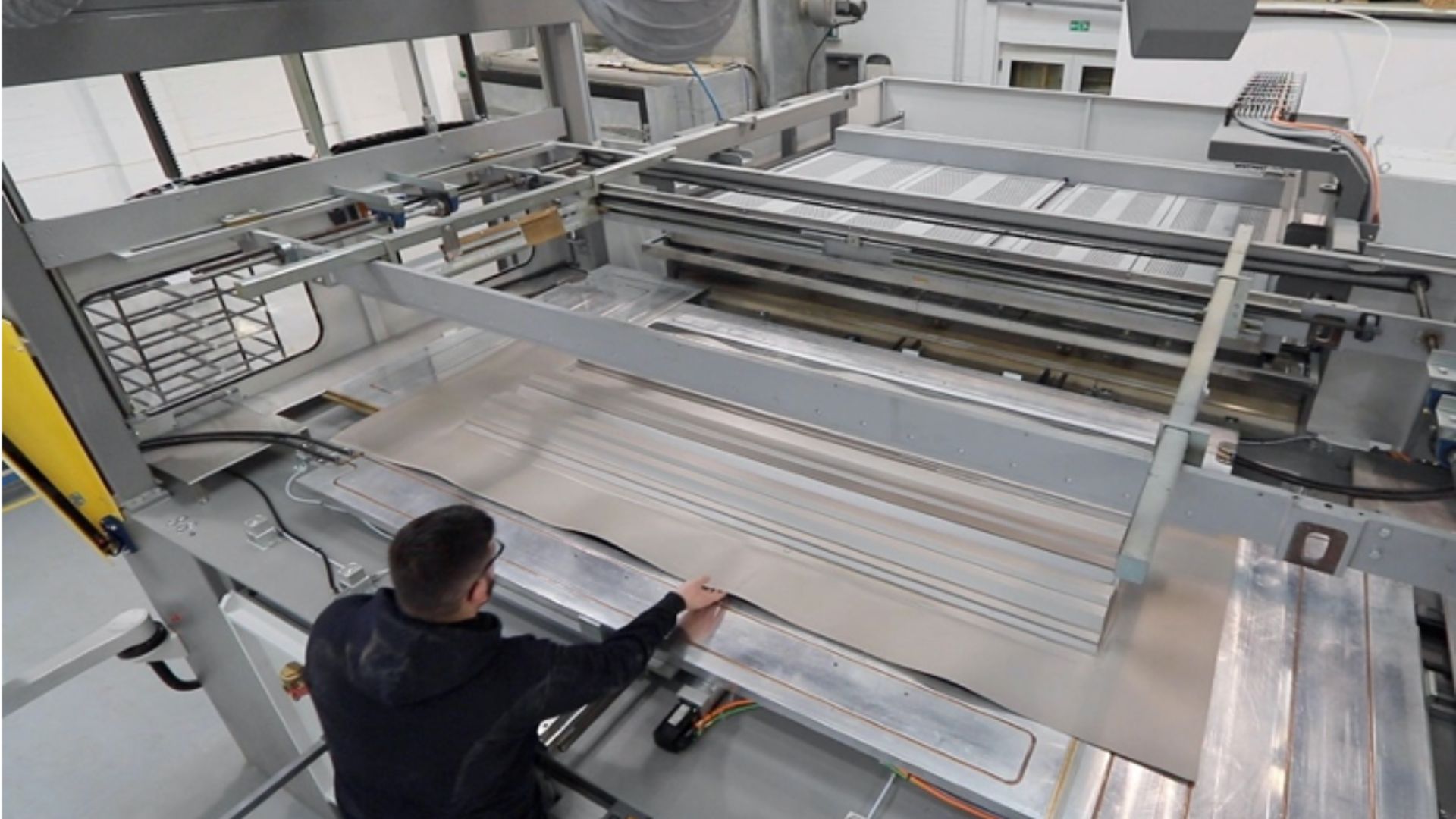
How It Works: A thermoplastic sheet is heated to its softening point in a controlled heater array. When the sheet reaches the target forming temperature (verified by sag depth or IR sensors), it is brought into contact with the mold.
In vacuum forming, vacuum ports remove air between the sheet and mold, pulling the material tightly against the surface.
In pressure forming, compressed air pushes the sheet into fine details, improving definition.
In plug-assist forming, a mechanical plug stretches the sheet before vacuum is applied to maintain uniform thickness.
After forming, the sheet cools, the part is removed, and trimming operations produce the final geometry.
Equipment: Sheet heaters, vacuum/pressure form stations, trim systems, and optional plug-assist tools.
Materials: ABS, HIPS, PETG, PVC, PC/ABS blends.
Applications: Enclosures, panels, trays, appliance housings, interior vehicle components.
Best For: Mid-volume production of large panels with low tooling cost and fast iteration.
Watch-Outs / Limitations: Lower detail accuracy than injection molding, trimming waste, limited to uniform wall thickness from sheet stock.
Together, these processes cover nearly every manufacturable plastic geometry, and understanding how each one actually forms a part is the foundation for choosing the right method for your application.
Plastic Molding Processes Compared
Choosing a molding method becomes far easier when you can see how the major processes differ side-by-side. This table summarizes all in one place.
Attribute | Injection Molding | Blow Molding | Extrusion | Compression Molding | Rotational Molding | Thermoforming |
|---|---|---|---|---|---|---|
Equipment Complexity | High (injection unit + clamp + steel molds) | Medium (extrusion/injection + blow station) | Medium (extruder + die + cooling) | Medium (heated press + matched dies) | Low (oven + biaxial rotation) | Low (heater + vac/pressure forming) |
Tooling Cost | High | Medium | Low–Medium | Medium | Low | Low |
Material Flexibility | Very wide thermoplastics | HDPE, PP, PET | PE, PP, PVC | Thermosets, rubber | PE powders only | ABS, HIPS, PETG |
Geometry Capability | Complex 3D parts | Hollow thin-walled parts | Continuous profiles | Thick structural sections | Large hollow bodies | Large thin-walled shells |
Tolerance Capability | Tightest | Moderate | Moderate | Moderate | Low | Low–Moderate |
Cycle Time | Fast (seconds) | Fast | Continuous | Slow (curing) | Very slow | Fast |
Best For | High-volume precision parts | Bottles, tanks, ducts | Pipes, profiles, films | Automotive panels, structural parts | Tanks, kayaks, bins | Enclosures, panels, trays |
Not Ideal For | Very large parts | Precision details | 3D shapes | Thin-wall parts | Fine detail | Complex/tight tolerances |
Once you see how each process compares, it becomes much easier to narrow down the options that align with your geometry, tolerances, and production goals.
How to Choose the Right Molding Process
Selecting the correct molding method is ultimately an engineering decision, one based on constraints, not guesswork. Use this framework to evaluate the six factors that determine which process fits your part, budget, and production targets.
1. Production Volume
Volume usually eliminates half the options instantly.
High volume (100,000+ parts/year): Injection molding → best unit cost, tight tolerances
Medium volume: Thermoforming, blow molding, compression
Low volume / large parts: Rotational molding, thermoforming, compression
If volume is high and tolerances matter → injection molding is almost always the answer.
2. Tolerance Requirements
Different molding methods have different accuracy ceilings.
Tightest tolerances: Injection molding
Moderate: Blow molding, extrusion
Lowest: Rotational molding, thermoforming
If you need precise dimensions, consistent wall thickness, or functional mating parts, you’re in injection molding territory.
3. Surface Finish Expectations
Cosmetic standards strongly influence process choice.
High-gloss, textured, Class A surfaces: Injection molding
Uniform, but less precise, finishes: Thermoforming, blow molding
Utility-grade surfaces: Extrusion, rotational molding, compression
If the part is customer-facing, choose a process with better surface replication.
4. Geometry Complexity
Some processes shape 3D features better than others.
Best for complex geometries: Injection molding
Best for hollow 3D shapes: Blow molding, rotational molding
Best for long continuous shapes: Extrusion
Best for large/simple shells: Thermoforming
Best for thick structural parts: Compression molding
If your part has undercuts, ribs, inserts, or multiple functional surfaces → injection molding wins.
5. Tooling Budget (Major Differentiator)
Tooling cost varies dramatically across processes.
Highest cost: Injection molding (multi-cavity steel molds, hot runners)
Medium cost: Blow molding, compression molding
Lowest: Rotational molding, thermoforming, extrusion dies
A low tooling budget naturally pushes teams toward rotomolding, thermoforming, or extrusion.
6. Material Compatibility & Performance Requirements
Match process to resin behavior:
Most thermoplastics: Injection molding
HDPE / PP / PET: Blow molding
PE/PP/PVC profiles: Extrusion
Thermosets (SMC/BMC) or rubber: Compression molding
LLDPE powders: Rotational molding
ABS/HIPS/PETG sheets: Thermoforming
If your material has strict melt handling requirements (e.g., PC, nylon, filled resins), injection molding gives better control.
Quick Decision Matrix
Requirement | Best Molding Process |
|---|---|
Tight tolerances | Injection molding |
Hollow shapes | Blow molding / Rotational molding |
Continuous profiles | Extrusion |
Large, low-volume parts | Rotational molding / Thermoforming |
Thick structural components | Compression molding |
High cosmetic finish | Injection molding / Thermoforming |
Lowest tooling cost | Rotational molding / Thermoforming |
Selecting the correct molding method is critical, but stable melt behavior is what makes that method perform reliably. MD Plastics focuses on that upstream foundation.
How MD Plastics Supports High-Performance Molding
Even the best molding process can only perform as well as the melt feeding it. Consistent melt temperature, stable viscosity, and controlled shear are what allow injection molds to hold tolerances, avoid defects, and maintain cycle time.
That’s where MD Plastics fits into the workflow, not by changing the molding process, but by improving the melt preparation that drives it.
Engineered Plasticating Components for Injection Molding
MD Plastics develops precision screws, barrels, and MDP™ non-return valves designed to deliver more uniform melting and more predictable shot-to-shot behavior. These components help processors:
Improve melt homogeneity across a wide range of thermoplastics
Reduce shear-induced degradation that leads to color shift or brittleness
Maintain stable backpressure and fill consistency
Support reliable production on both legacy and modern injection machines
The focus is always on controlling the melt profile, not forcing the machine to compensate for unstable melt quality.
Better Melt Quality → Better Molded Parts
Consistent melt improves outcomes across nearly every molding process:
Fewer burn marks from overheated or degraded resin
More uniform flow into thin-wall features
Better cosmetic surfaces due to stable viscosity
Reduced splay and gas traps caused by inconsistent melt temperature
More predictable packing and shrink behavior
Stable melt isn’t an upgrade; it’s the foundation the rest of the process depends on.
Retrofit Capabilities for Existing Molding Machines
Many plants don’t need a new machine to improve part quality. MD Plastics can retrofit:
Screws tailored to resin type and throughput goals
Optimized barrels to stabilize heat transfer
High-performance non-return valves for clean, repeatable shutoff
This lets processors improve melt performance and reduce variability without replacing presses or rebuilding entire molding cells.
Real-Time Melt Monitoring (Melt-IQ® & Melt-Profiler™)
MD Plastics’ melt-monitoring technologies give processors visibility into the melt itself, not just barrel zones or clamp force.
These systems provide:
Real-time melt temperature and pressure data
Viscosity curves that correlate directly to part quality
Early wear detection inside the barrel/screw system
Insight into shear loading and thermal stability
This data helps identify issues long before they show up as scrap, allowing for predictive maintenance and more stable molding conditions.
By improving melt preparation and giving processors direct insight into melt behavior, MD Plastics helps every molding process, from injection to blow to extrusion, run with fewer defects, more consistency, and greater confidence in part quality.
If melt stability is limiting your part quality, consider an MD Plastics melt audit to identify where improvements can be made.
Conclusion
Plastic molding is a set of specialized manufacturing methods, each designed for a specific combination of geometry, tolerances, volume, and material behavior. Choosing the right process upfront prevents defects, controls cost, and sets the foundation for repeatable, efficient production.
No matter which method you choose, whether it’s injection molding for precision, blow molding for hollow parts, extrusion for continuous profiles, thermoforming for large shells, compression for structural components, or rotational molding for oversized hollow forms, the quality of the melt entering the tool ultimately shapes part consistency.
If your molding results depend on stable melt delivery, MD Plastics can help evaluate and upgrade the plasticating side of your process to support cleaner, more consistent production.
FAQs
1. Which molding process is best for high-volume production?
Injection molding offers the lowest unit cost, fastest cycle times, and tightest repeatability at scale.
2. Which process has the lowest tooling cost?
Rotational molding and thermoforming both use low-pressure molds that are far cheaper than steel injection molds.
3. Which molding method supports the tightest tolerances?
Injection molding provides the highest dimensional control and surface detail.
4. What materials fit best with injection vs blow, vs extrusion?
Injection: ABS, PP, PC, Nylon
Blow: HDPE, PP, PET
Extrusion: PE, PP, PVC (profiles, pipes, films)
5. How do I choose the right process for my part?
Match your volume, tolerances, geometry complexity, material needs, and tooling budget to the process that aligns with them.