Every defective plastic part has the same origin point, and it isn’t the mold, the machine, or the cycle settings. It starts upstream, in the melt.
When the melt is right, nearly every downstream step becomes predictable.
When it’s wrong, no amount of tweaking at the machine will fix it.
Across injection molding, extrusion, and blow molding, roughly 90% of quality problems trace back to melt behavior: viscosity shifts, shear hotspots, thermal gradients, unmixed additives, or subtle degradation that operators can’t see.
The challenge is simple: processors rely on barrel temperatures, screw speeds, and pressure settings, but none of these machine “settings” reveal the actual condition of the melt inside the barrel or at the nozzle.
This guide breaks that gap open.
You’ll find a technical, engineering-level explanation of how the melt is formed, how it behaves under heat and shear, how machine components influence it, and how to diagnose defects at their source.
And for the first time, we’ll connect Melt Science to modern melt-monitoring tools that make the melt visible, turning an invisible process into one you can finally control.
Key Takeaways
Melt quality drives part quality. Most processing defects originate from variations in melt temperature, viscosity, or homogeneity, not the mold or machine.
Melting is a thermomechanical process. Heat, shear, pressure, mixing, and residence time collectively define how the melt behaves.
Machine settings don’t reveal melt conditions. Steel temperatures and setpoints can’t show shear heat, resin variability, or component wear.
Consistent production requires structured melt control. Stability comes from tuning temperature, shear, backpressure, residence time, and pressure repeatability.
Direct melt measurement changes everything. MD Plastics’ sensors and engineered components provide real melt data and improve upstream melt preparation.
What Is Polymer Melt Processing?
Polymer melt processing is the deliberate conversion of solid polymer pellets into a stable, fully developed molten phase with the temperature, viscosity, and homogeneity needed for precise shaping.
It is not simply “heating plastic”; it is a controlled mechanical and thermal transformation where the material undergoes melting, mixing, pressurization, and flow conditioning inside the screw and barrel.
Melt processing has clear inputs: pellet temperature, resin properties, screw geometry, barrel configuration, shear rate, and pressure.
And equally critical outputs: melt temperature, viscosity profile, density, homogeneity, and stability at the point of injection or extrusion.
These outputs determine how the material fills, cools, bonds, and ultimately performs in the final part.
A key misconception is treating melt as a single temperature value. In reality, the melt is a dynamic, multi-variable fluid whose behavior changes continuously with shear, pressure, thermal gradients, and residence time.
Understanding this dynamic behavior, not just the machine settings around it, is what enables consistent, high-quality polymer processing across injection molding, extrusion, blow molding, and compounding.
What Really Governs Polymer Melt Behavior?
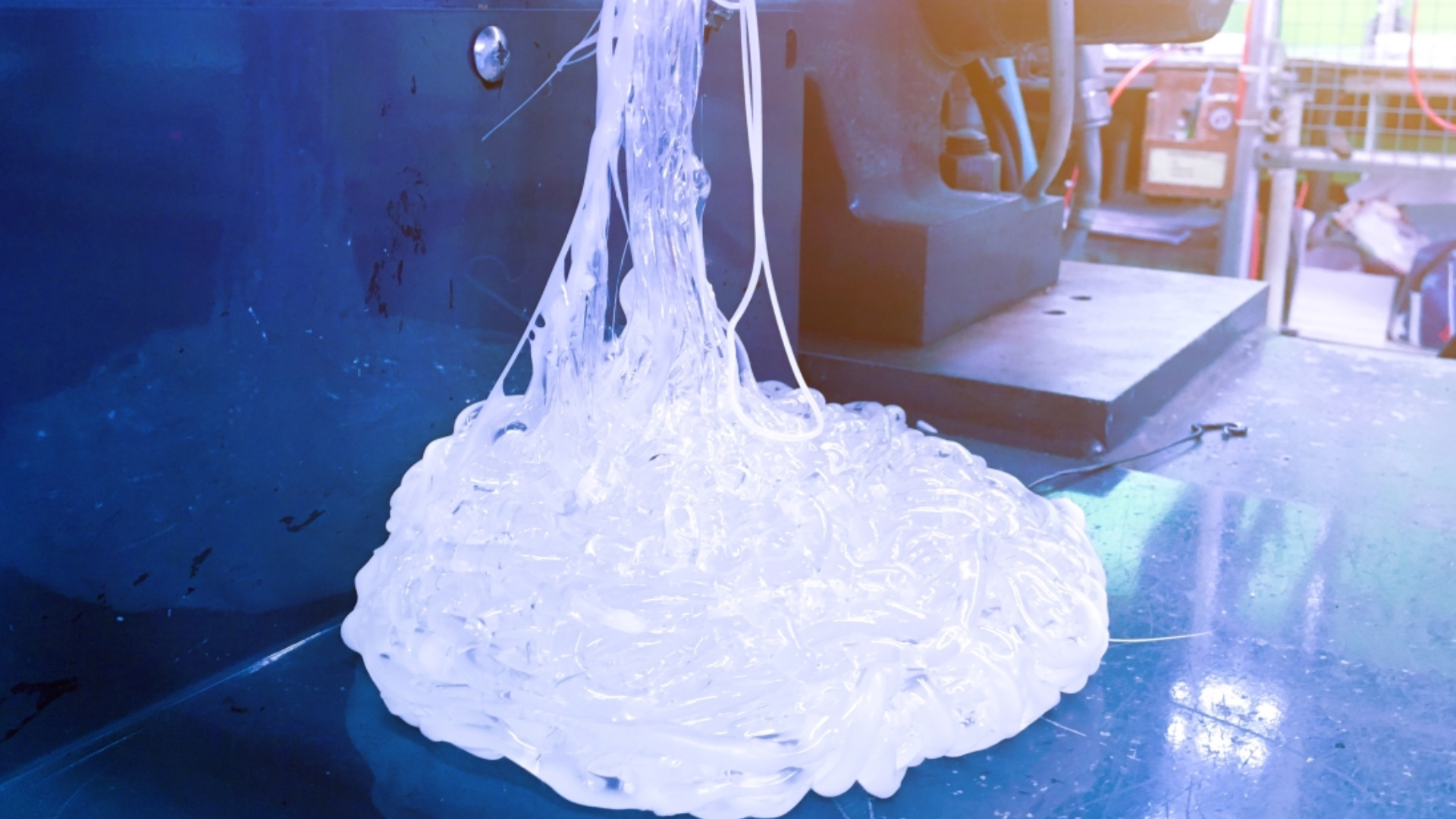
Polymer melt behavior is governed by a set of physical principles that determine how the material softens, flows, stretches, recovers, and degrades under processing conditions.
Understanding these fundamentals allows engineers to predict melt stability and explain why two materials with the same barrel settings can behave completely differently once inside the screw and barrel.
How do Polymers Melt? (Thermoplastic vs. Thermoset)
Thermoplastics melt because their molecular chains are held together by secondary forces; heat and shear break these interactions, allowing the material to transition into a flowable state.
Crystalline polymers show a sharp melting point as ordered regions collapse; amorphous polymers soften gradually because they lack a defined crystal structure.
Thermosets behave differently: once crosslinked, they no longer melt. Heat only accelerates degradation.
For processors, this distinction matters because melting is not a simple temperature event; it’s a balance of heat input, shear, crystallinity, and resin chemistry that defines the usable processing window.
Viscosity, Shear & Temperature Interactions
Viscosity is the melt’s resistance to flow, and it changes continuously inside the machine. Most polymers are shear-thinning; their viscosity decreases as shear rate increases, making screw rpm, compression, and screw design major influencers of flow behavior.
Temperature also reduces viscosity, but not in the same pattern as shear.
Pressure increases it. These three variables, temperature, shear, and pressure, interact constantly, meaning the melt’s state cannot be inferred from a single machine reading.
Viscosity is the master variable: it controls filling, mixing efficiency, required injection pressure, and the overall stability of the melt.
Orientation, Relaxation & Elasticity (Die Swell)
When polymer chains are stretched by shear or extensional flow, they become oriented, storing elastic energy in the melt.
If the melt does not have time to relax before exiting the screw, gate, or die, that energy is released, causing die swell, distortion, halo effects, or frozen-in stresses.
Orientation influences optical clarity, warpage, shrinkage behavior, and impact resistance.
Materials with slower relaxation times tend to retain orientation longer, making process timing and shear level critical to part quality.
Degradation, Oxidation & Residence Time
Melt is vulnerable to different forms of degradation.
Thermal degradation occurs when material stays too hot for too long, breaking molecular chains and reducing mechanical strength.
Oxidative degradation occurs when oxygen contacts hot polymer common at open nozzles, vents, or after prolonged residence time.
Residence time amplifies both effects: the longer material remains in the barrel, the greater the chance of discoloration, gels, black specks, odor, or brittleness.
For processors, degradation isn’t just a temperature issue; it’s a function of shear, oxygen exposure, barrel loading, screw design, and purge discipline.
How does the Plasticating Unit form the Melt?
Polymer melt is shaped by the combined effects of temperature, shear, pressure, mixing, and residence time inside the plasticating unit. Every component in the melt path influences these variables, meaning the melt’s final condition is a mechanical outcome, not just a thermal one.
Heat Transfer in the Barrel
The barrel adds energy through two mechanisms:
Conduction from heater bands
Shear heating from the screw wiping and compressing the resin
In most polymers, shear heating provides the majority of the melting energy. This is why barrel temperature readings seldom match true melt temperature; thermocouples measure steel, not melt.
As the polymer softens, it melts unevenly across the channel, creating thermal gradients that influence viscosity uniformity, stability, and degradation risk.
Screw Zones, Geometry & Mixing Functions
The screw is the primary melt generator. Resin travels through the:
Feed zone (solid conveying)
Transition zone (melting and compression)
Metering zone (homogenization)
Key geometric features, flight depth, channel volume, pitch, and compression ratio—control how quickly resin melts and how uniformly it mixes.
Mixing sections (distributive and dispersive) break up solids, distribute additives, and even out viscosity. Because the screw dictates shear, residence time, and melting rate, it has a greater influence on melt quality than heater settings.
Backpressure & Melt Density Control
Backpressure compresses the melt during screw recovery, improving mixing and stabilizing viscosity. Proper backpressure helps:
Increase melt density
Eliminate unmelted particles
Improve color and additive dispersion
But the window is narrow.
Too high: unnecessary shear heat, risk of degradation
Too low: poor mixing, streaks, inconsistent melt density
Shot stability often traces back to backpressure settings.
NRV (Check Valve) Behavior & Shot Consistency
The NRV prevents melt from flowing backward during injection. When worn or inconsistent, it causes:
Shot volume variation
Instability in the melt viscosity distribution
Pressure inconsistency
Disturbed shear history in the metering zone
Because the NRV is the final control element in melt preparation, its condition has a direct effect on repeatability and dimensional stability.
Nozzle/Gate Thermal Stability
The nozzle is a critical thermal transition point. Temperature instability here leads to:
Cold slugs
Stringing or drool
Freeze-off variation
Shifts in melt viscosity at the point of injection
Even small temperature drops at the nozzle or gate can alter flow fronts and weld-line quality. A stable nozzle temperature ensures the melt enters the mold with the properties the upstream process intended.
The Five Pillars That Shape Melt Behavior
These five pillars: temperature, shear, pressure, mixing, and residence time, define the melt’s internal structure, stability, and readiness for injection or extrusion.
Understanding how each pillar influences the melt gives processors direct leverage over flow behavior, consistency, and downstream quality.
1. Temperature
What it controls: Melt temperature profile, viscosity, thermal stability.
Symptoms of instability: Hot/cold streaks, burning, incomplete melting, viscosity swings.
Defects: Splay, burn marks, short shots, cosmetic variation.
Adjustments:
Refine zone settings (don’t chase barrel temps, verify melt temp.)
Improve heat balance across zones.
Reduce heat loss at the nozzle or gate.
2. Shear
What it controls: Shear heating, viscosity reduction, mixing intensity.
Symptoms of instability: Excessive shear heat, unmelted particles, inconsistent color, noisy pressure curves.
Defects: Degradation, streaking, gels, and dimensional inconsistency.
Adjustments:
Optimize screw rpm.
Select the proper screw geometry for resin.
Control backpressure to regulate shear input.
3. Pressure
What it controls: Melt compaction, density, shot consistency, cavity fill performance.
Symptoms of instability: Shot-to-shot variation, fluctuations in plasticizing pressure, uneven packing.
Defects: Short shots, sinks, variable part weight, weak weld lines.
Adjustments:
Tune backpressure for stable density.
Ensure NRV sealing performance.
Maintain stable injection/packing profiles.
4. Mixing
What it controls: Temperature uniformity, additive distribution, color consistency, and melt homogeneity.
Symptoms of instability: Color streaks, unmixed masterbatch, temperature bands within the melt.
Defects: Flow marks, haze or poor clarity, brittle sections, cosmetic inconsistency.
Adjustments:
Increase backpressure moderately.
Use appropriate mixing screw sections.
Verify screw/barrel wear that reduces mixing efficiency.
5. Residence Time
What it controls: Thermal history, degradation exposure, and additive stability.
Symptoms of instability: Yellowing, odor, gels, black specks, and inconsistent viscosity.
Defects: Brittle parts, surface contamination, degradation-related failures.
Adjustments:
Reduce barrel capacity relative to shot size.
Improve purge discipline and changeover procedure.
Lower temperatures in long-residence applications.
Once the melt leaves the screw, the conditions it encounters change sharply from one process to another, and those differences dictate how the melt must be conditioned beforehand.
Process-Specific Melt Behavior: A Quick Comparison

Each manufacturing method imposes different stresses, flow patterns, and thermal conditions on the melt.
Even with the same material and machine settings, melt behavior can shift dramatically depending on whether the process is cyclic, continuous, stretch-driven, or mixing-intensive.
Understanding these differences helps processors tune melt preparation to the specific demands of the operation.
Injection Molding:
Melt behavior is dominated by rapid shear during plasticizing and high-pressure flow during injection. The melt must be uniform before entering the gate, because the mold freezes orientation quickly.
Any thermal or viscosity variation upstream can lead to inconsistent filling, weak weld lines, cosmetic issues, and dimensional drift.
Extrusion:
Extrusion places the melt under continuous shear, making melt strength and elastic recovery critical. Die swell, pressure stability, and output uniformity depend on consistent melt temperature and viscosity across the screw.
Poor melt homogeneity shows up as dimensional variation, surface roughness, and instability at the die exit.
Blow Molding (EBM, IBM, ISBM):
Blow molding demands a melt with predictable stretch behavior. In extrusion blow molding, the parison requires sufficient melt strength to hang without sagging.
In injection stretch blow molding, orientation, relaxation, and thermal uniformity directly affect clarity, wall thickness, and mechanical performance. Even minor melt instability becomes highly visible.
Compounding / Twin-Screw Processing:
Compounding focuses on intensive distributive and dispersive mixing. Melt viscosity, shear sensitivity, and residence-time distribution dictate how well additives, fillers, and pigments disperse.
Inconsistent melt temperature or shear leads to poor dispersion, agglomerates, and mechanical property loss downstream.
Comparative Melt Behavior Table
Process | Key Melt Demands | Instability Symptoms | Why It Matters |
|---|---|---|---|
Injection Molding | Uniform viscosity, consistent temperature, stable shear history | Short shots, weak weld lines, cosmetic defects, and dimensional drift | Mold freezes orientation instantly; poor melt = unpredictable filling |
Extrusion | Steady shear, stable melt strength, uniform temperature | Die swell variation, surface defects, and output pulsation | Continuous flow amplifies any melt fluctuation |
Blow Molding | Controlled stretchability, strong melt strength, uniform thermal profile | Parison sag, haze, thin-spot formation, weak impact performance | Clarity and wall distribution depend on melt relaxation and stability |
Compounding | Balanced shear, tight RTD, effective dispersive/distributive mixing | Poor dispersion, agglomerates, streaking | The additive/mixing quality directly determines the downstream part performance |
Recognizing how each process interacts with the melt makes it easier to trace quality issues back to their true source, the condition of the melt at the moment it enters the mold or die.
Melt Defects & How to Solve Them
Most defects blamed on molds, tooling, or cycle settings actually originate in the melt long before it reaches the cavity or die.
Variations in viscosity, temperature, shear history, or material uniformity can create unstable flow behavior, which later manifests as cosmetic, dimensional, or structural issues.
Mapping defects back to upstream melt conditions provides processors with a clearer path to fast and reliable fixes.
Melt Defect Root-Cause Table
Defect | Underlying Melt Cause | Machine / Component Cause | Quick Fix (Upstream) |
|---|---|---|---|
Splay | Moisture flash, volatile release, temperature instability | Inconsistent melt temperature, poor mixing, excessive shear | Dry resin properly; stabilize melt temp; reduce rpm; verify screw/barrel wear |
Burning | Excessive shear heat, degradation, trapped air | Overheated melt zones, high backpressure, poor venting | Lower shear and temps; reduce backpressure; check for dead spots or leakage |
Voids | Low melt density, trapped gases, uneven packing | Inadequate backpressure, poor melt compression, NRV leakage | Increase backpressure; verify NRV seal; improve melt homogeneity |
Short Shot | High viscosity, uneven melt temperature, and incomplete melting | Low barrel temps; worn screw or NRV; insufficient shear | Increase melt temperature; increase rpm moderately; check NRV function |
Warpage | Uneven shrinkage from non-uniform melt temperature or orientation | Temperature gradients, inconsistent backpressure, and unbalanced mixing | Stabilize melt temperature; improve mixing; verify screw geometry/wear |
Flow Marks | Viscosity fluctuations, unstable shear, poor thermal uniformity | Irregular screw speed; temperature band swings; cold nozzle | Smooth rpm; stabilize zones; ensure nozzle temperature uniformity |
Poor Clarity | Orientation, unmixed additives, micro-gels, thermal bands | Inadequate mixing; hot spots; colorant streaking | Add mixing capability; tune backpressure; reduce shear hotspots |
Die Lines (Extrusion) | Local viscosity differences, contamination, and elastic memory | Die imbalance; inconsistent melt strength; partial unmelt | Improve mixing; raise melt uniformity; stabilize shear; inspect die |
Parison Sag (Blow Molding) | Insufficient melt strength, low viscosity stability | Melt too hot; weak mixing; improper screw design | Lower melt temp; adjust rpm/backpressure; use screw with better melt strength |
Black Specks / Gels | Degradation, long residence time, contamination pockets | Dead spots in barrel/nozzle; worn screw; carbon buildup | Purge thoroughly; reduce residence time; inspect screw/barrel for wear |
Most of these defects can be eliminated before they appear simply by controlling the upstream melt conditions, a process covered in the next section’s optimization framework.
How to Optimize Melt Processing?
Optimizing melt processing isn’t about chasing individual machine settings; it’s about controlling the conditions that shape viscosity, thermal uniformity, and melt density.
The steps below form a practical framework that processors can apply across materials, machines, and processes.
1. Temperature Profiling
Objective: Achieve a stable, uniform melt temperature, not just correct barrel settings.
How to optimize:
Start with a flat or slightly increasing temperature profile; adjust based on melt feedback, not heater readings.
Verify actual melt temperature with in-nozzle or in-melt measurement when possible.
Reduce unnecessary zone temperatures to avoid hot spots or degradation.
Address heat loss at the nozzle to prevent cold slugs and viscosity shifts.
Common gains: More consistent viscosity, reduced splay/burning, fewer thermal bands within the melt.
2. Screw Speed & Shear Control
Objective: Control shear heating and melting rate without overworking the material.
How to optimize:
Increase rpm only enough to achieve full, uniform melting.
Reduce rpm if shear-induced hotspots or degradation appear.
Match screw design to resin behavior. Shear-sensitive materials require gentler geometry.
Balance rpm with backpressure to maintain stable shear input.
Common gains: Improved color dispersion, fewer gels, smoother pressure curves.
3. Backpressure Window
Objective: Establish the minimum backpressure needed for uniform melt density and effective mixing.
How to optimize:
Raise backpressure until viscosity and shot weight stabilize; avoid excessive values that introduce heat.
Monitor mixing quality (unmixed color, unmelted particles) as feedback.
Adjust in small increments, backpressure changes compound quickly with screw speed.
Reassess backpressure when changing materials or additives.
Common gains: Better melt homogeneity, stable cavity fill, reduced cosmetic variation.
4. Residence Time Management
Objective: Prevent thermal history from degrading the polymer.
How to optimize:
Reduce barrel capacity if the shot size is small relative to screw volume.
Lower temperatures are required in long-residence applications or when using heat-sensitive materials.
Purge consistently during idle periods to prevent carbon buildup.
Follow structured changeover procedures to avoid contamination.
Common gains: Fewer black specks, reduced yellowing, improved clarity, and mechanical stability.
5. Pressure Repeatability
Objective: Maintain stable melt density, viscosity, and material delivery into the mold.
How to optimize:
Tracking plasticizing pressure trends and variations indicates melt inconsistency.
Inspect NRV condition if holding or injection pressure drifts.
Keep screw recovery parameters stable; avoid rpm/backpressure swings.
Evaluate nozzle temperature for drop-induced viscosity shifts.
Common gains: Predictable part weight, reduced dimensional variation, and more consistent mechanical properties.
Quick Reference table:
Optimization Step | Key Signals to Watch | Common Symptoms | Primary Adjustments |
|---|---|---|---|
Temperature Profiling | Melt temp uniformity | Splay, burning, thermal bands | Adjust zone temps; verify nozzle heat |
Screw Speed / Shear | Pressure curve stability | Gels, streaks, hotspots | Tune rpm; evaluate screw geometry |
Backpressure Window | Shot weight repeatability | Poor mixing, density swings | Raise/lower BP in small increments |
Residence Time | Color shift, odor, specks | Degradation, gels | Reduce temp; adjust barrel capacity; purge |
Pressure Repeatability | Injection/holding stability | Weight variation, short shots | Inspect NRV; stabilize screw recovery |
The Gap Between Machine Settings and Actual Melt Conditions
The machine displays a report of what the hardware is doing, and the quality depends on what the melt is doing. Below are the specific gaps that separate the two and why they matter for stability.
1) Heater bands report steel temperature, not polymer state
Identical zone profiles can yield different melt conditions as soon as throughput, screw load, or resin changes. What matters is the melt’s thermal profile at the screw tip, not the band setpoints.
2) Thermocouples are point readings in a non-uniform field
They miss cross-section gradients, hot/cold pockets, and channel-to-channel variation created by screw geometry and pack density—so operators often “fix” the wrong thing.
3) Shear adds unreported heat
RPM, backpressure, and viscosity shifts can move melt temperature by tens of degrees with no change on the barrel display. This is thermal energy that the HMI never shows.
4) Materials respond differently under the same settings
Crystalline vs. amorphous, filled vs. neat, recycled content, and moisture level each change melting behavior, relaxation time, and shear sensitivity. One recipe of settings cannot produce one melt outcome across resins.
5) Critical melt signals aren’t measured by default
What you need for real control in-melt temperature, in-melt pressure, viscosity/flow index, density trends, and stability over time isn’t available from legacy control loops, so processors are forced to infer from symptoms.
Takeaway: Machine parameters are proxies. To stabilize quality, you need direct melt measurements where the material is actually used at the screw tip/nozzle, and you need them every cycle.
To replace guesswork with control, the next section shows how in-line melt sensing makes temperature, pressure, and viscosity visible at the point of use.
How MD Plastics Enables Melt Measurement and Stability
Once you recognize that machine parameters don’t describe melt conditions, the next question becomes: What information does a processor actually need to control melt quality?
The answer lies in measuring the melt directly at its temperature, pressure, viscosity, and stability at the point where it matters most. MD Plastics’ monitoring tools and engineered components were developed precisely to close this data gap.
What Melt Data Processors Actually Need
Stable processing requires real-time visibility into the melt’s internal state, not just machine readings. The critical signals are:
True melt temperature: the actual thermal condition of the polymer, not the steel.
Melt pressure: indicates compaction, density, and shear load.
Viscosity (in-melt): the most reliable measure of flow behavior, far more telling than setpoints.
Shear history: reveals whether the melt was overworked or insufficiently mixed.
Density trends: key for shot-to-shot repeatability.
Cycle-to-cycle stability: the signature of a predictable melt.
Without this data, processors rely on inference, adjusting temperature, rpm, or backpressure to react to symptoms rather than prevent them.
Melt-Profiler™: Real Melt Temperature, Pressure & Viscosity Profile
The Melt-Profiler™ places sensors where the melt is actually flowing, capturing its true thermal and mechanical state. It provides:
In-melt temperature at the screw tip or nozzle
Dynamic melt pressure during plasticizing
Real viscosity curves derived from pressure–flow relationships
By monitoring these variables over time, processors can detect wear, poor mixing, thermal gradients, and shear instability before defects appear.
It replaces guesswork with measurable, actionable melt data.
Melt-IQ®: Predictive Quality Index & Instability Alerts
Melt-IQ® converts raw melt data into a quality stability index, showing how consistent the melt is from cycle to cycle. It:
Flags thermal or viscosity drift
Identifies early signs of NRV wear or screw degradation
Predicts instability before it affects the part
Helps processors maintain a stable processing window without chasing symptoms
Instead of adjusting based on part defects, Melt-IQ® helps engineers prevent defects altogether.
Temp-Sense™: Direct Point-of-Use Melt Temperature Measurement
Temp-Sense™ measures melt temperature exactly where it matters: at the point of injection or extrusion. It eliminates the uncertainty of thermocouples and provides:
Real melt temperature at the nozzle
Rapid detection of cold slugs, hot spots, or freeze-off issues
Clear insight into how screw rpm, shear, or throughput affect actual melt temp
This is melt temperature in its truest form, not inferred from steel.
Engineered Screws, Barrels & NRVs That Improve Melt Preparation
Monitoring is only half of the solution. MD Plastics also designs components that directly improve melt development:
Posi-Melt™ screws for uniform melting, controlled shear, and optimized mixing
Wear-resistant barrels for stable compression and consistent thermal behavior
Precision NRVs that maintain sealing performance and protect melt quality
Shut-off nozzles that maintain temperature integrity and reduce drool/variation
Better components reduce variation at the source, while monitoring tools verify melt stability in real time.
Together, these tools give processors something they’ve never had before: direct visibility into melt behavior and the ability to control the melt with engineering precision.
If you want to move beyond machine settings and truly control your polymer melt its temperature, viscosity, density, and stability, MD Plastics can help.
We take an analytical, science-driven approach to melt processing: studying your equipment, your screw and barrel conditions, and your actual melt behavior to engineer solutions that eliminate upstream variability.
If you’re ready to see what your melt is really doing and how to optimize it, request a melt analysis today!
Conclusion
Across every molding and extrusion process, melt quality is the first variable that determines part quality, stability, efficiency, and repeatability.
Machine settings can influence the melt, but they cannot describe it.
The only reliable path to consistent production is melt-first thinking, understanding how the melt is actually formed, how it behaves under heat and shear, and how upstream variation creates downstream defects.
Modern melt monitoring finally makes this possible. By measuring melt temperature, pressure, viscosity, and stability at the point of use, processors can stop reacting to defects and start controlling the melt with intention.
To see how real melt data transforms processing outcomes, explore our case studies. They show exactly how engineering-level melt visibility improves consistency, solves chronic defects, and increases productivity.
FAQs
1. What is polymer melt processing?
It’s the controlled transformation of solid polymer into a homogeneous molten phase with the temperature, viscosity, and stability needed for molding or extrusion. Melt processing combines heat, shear, pressure, mixing, and residence time, not just barrel temperature.
2. Why is melt temperature different from barrel temperature?
Barrel heaters warm the steel, but the melt gains most of its heat from shear. As a result, the true melt temperature can be significantly higher or lower than the thermocouple reading, depending on screw speed, resin behavior, and throughput.
3. How do screw or NRV wear impact melt quality?
Worn screws reduce melting efficiency and mixing capability, creating viscosity and thermal variation.
A worn NRV leaks during injection or recovery, causing:
inconsistent shot volume
shifting melt density
unstable viscosity distribution
This is one of the most common sources of repeatability problems.
4. How do you measure melt accurately?
Accurate melt measurement requires sensors placed directly in the melt stream. Tools such as Melt-Profiler™ and Temp-Sense™ measure:
in-melt temperature
melt pressure
viscosity (derived from pressure–flow data)
Machine setpoints alone cannot provide this information.
5. What causes melt-related defects?
Most melt defects come from instability in temperature, shear, mixing, pressure, or residence time. These conditions create non-uniform viscosity, degradation, trapped gases, or poor homogeneity, leading to issues like splay, warpage, short shots, gels, and poor clarity.